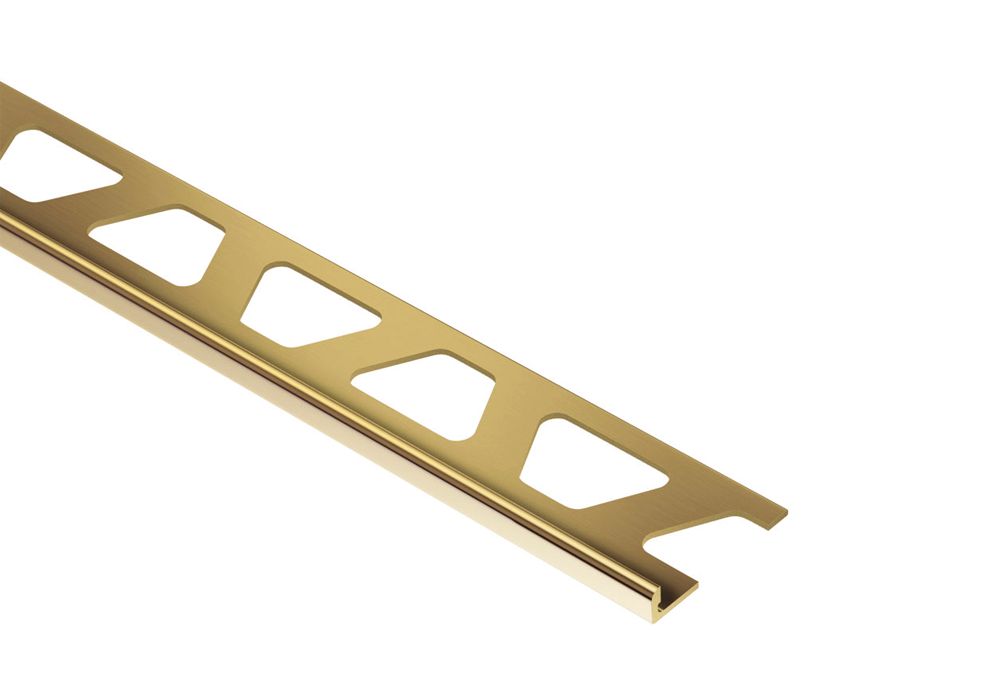
Schluter M45 Schiene Edge Trim 3/16" Brass
Internal Reference:
SCH-M45
Schluter M45 Schiene Edge Trim 3/16" Brass
Schluter-SCHIENE
Finishing and edge-protection profile with minimum reveal
Schluter-SCHIENE provides effective and attractive edge protection for tile coverings that are typically bordered by carpet, at expansion joints, or as decorative edging for stairs. The profile offers a discreet, minimum reveal which is ideal for creating elegant transitions between floor coverings.
New! Now available in 10 (3.05 m) lengths
Prevents tiles from chipping
Ideal for creating transitions on floors
Ideal for floor installations, where tile is bordered by carpet or wood
Features an approximately 1/8" (3 mm)-wide visible surface for discreet transitions
Anchoring leg is available with a special radius perforation so that the profile can be used to form curves
87 slope to transfer point loads and protect tile edges
Available in stainless steel, solid brass, aluminum, and anodized aluminum
SCHIENE EDGE TRIM 3/16" BRASS
Product Code: M45
Schluter-SCHIENE is designed to provide edging for tile coverings. Typical applications include edge protection where tile is bordered by carpet, at expansion joints, or as a decorative edging for stairs.
SCHIENE is available in stainless steel, solid brass, aluminum, and anodized aluminum. The profile features a trapezoid perforated anchoring leg, which is secured in the mortar bond coat beneath the tile, and an 87 sloped vertical wall section that transfers point loads to the substrate and surface covering while protecting tile edges from damage. SCHIENE, in solid brass, aluminum, and anodized aluminum, features a 5 sloped top flange and fillet at the anchoring leg/vertical section interface to enhance edge protection by reducing stresses on the tile, and, in sizes greater than 1/4" (6 mm), features an integrated joint spacer that establishes a defined joint cavity between the tile and the profile.
The anchoring leg of SCHIENE, in all materials, is available with a special radius perforation R so that the profile can be used to form curves.